
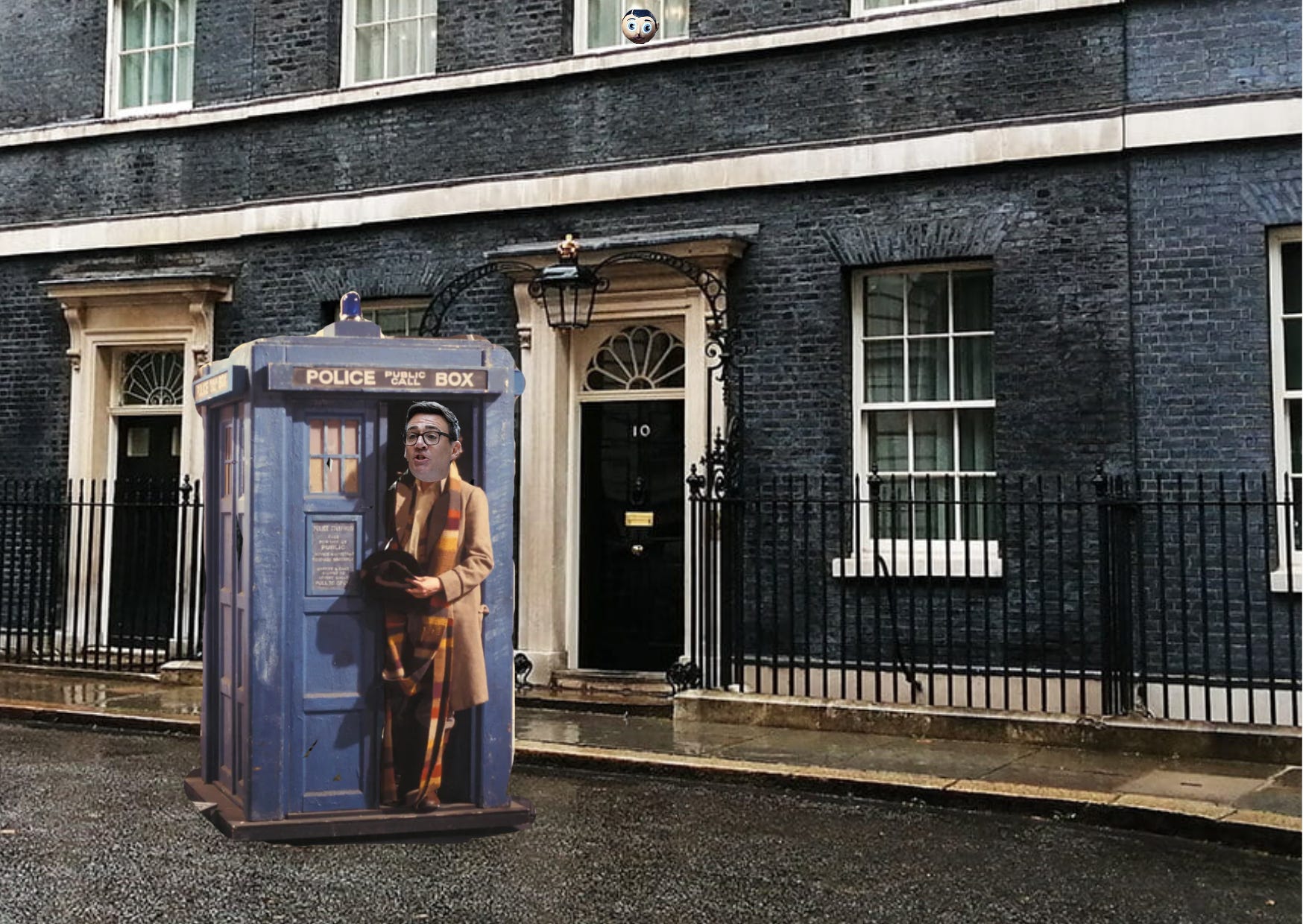
Andy Burnham's Time Machine
What did the presumptive Prime Minister's first speech look like to the newspaper that was always destined to hate it most? Let's tumble into Telegraph world...
The paperback of Breaking: How the Media Works, When It Doesn’t, and Why it Matters is out on August 27. If you enjoy this newsletter, please think about pre-ordering a copy!
Previously: Sketches of a Burnaissance Man
When Andy Burnham finished speaking in Manchester yesterday, he didn’t take any questions from the media. It was a strategic choice to force journalists to focus on what he said rather than what they or one of their colleagues decided to ask him about. It’s a move that worked this time but isn’t sustainable in the long term. If he is seen to duck scrutiny when he finally makes it through the door of Number 10, the media will be very quick to paint him as a coward; the illegitimate occupant of Downing Street who doesn’t even allow questioning.
Even in the absence of an opportunity to lob questions at Burnham, the British press is extremely able to frame a speech as representing everything they love or, most likely, hate. That’s why I wanted to turn today’s newsletter over to looking specifically at how one newspaper responded to Burnham’s performance — The Daily Telegraph. In the battle to be Fleet Street’s most unhinged, the Telegraph currently holds the lead, pushing even the Mail into second place.
In penning their scary stories for shire Tories, Telegraph writers often reach back to a peak time for folk horror — the 1970s. That’s exactly the tactic with Burnham, who they’ve decided to present as a man obsessed with some idealised era of brown corduroy, flat caps, whippets, and union barons trooping into Downing Street for slowly curling sandwiches and protracted negotiations.
The paper’s leader column today opens:
Andy Burnham delivered his first major speech since returning to Westminster, looking and sounding like a throwback to the 1970s. In his trademark black T-shirt, sporting a badge and speaking in Manchester’s People’s History Museum, he was almost a parody of a Citizen Smith-style Left-wing politician.
Citizen Smith, the sitcom starring Robert Lindsay as the Wolfie Smith, the Marxist revolutionary leader of the Tooting Popular Front, stopped airing new episodes in 1980. You need to be well in your sixties to have a decent memory of it. But that’s the key here; the Telegraph wants to harness the ghost of Margaret Thatcher against Burnham, to cast him as a man out to destroy the legacy of their sainted Maggie:
Margaret Thatcher came to power in 1979 to undo the damage caused by the very socialist interventionism that Mr Burnham now seeks to revive. He gave the impression that this would be different because powers would be delegated to cities and regions and vested in local mayors. He even promised to set up his office in Manchester for at least part of the time in a “Number 10 of the North”.
In 2002, Thatcher was asked for her greatest achievement and she replied: “Tony Blair and New Labour. We forced our opponents to change their minds.” Three years later, David Cameron described himself, in an incautious comment to newspaper executives, as “the heir to Blair”. Now the Telegraph wants to terrify its readers with the prospect that Thatcherism might not be permanently baked in to British society.
Lord Frost, the former government Brexit negotiator with a Batman villain’s name, pops up elsewhere in the Telegraph to tell the same scary seventies story:
It’s a brave politician who chooses to give his first keynote speech in a museum, but for Andy Burnham it seemed somehow appropriate. For his entire speech was something of a museum piece, an artefact redolent of the Michael Foot days of Labour politics: strikes and trade union banners, class warfare in Parliament and ranting Leftists on the streets. The public sector, nationalisation, the unions, the state, splashing around public money – these are Burnham’s tools to make things better. We know how this story ends.
He also took time to bring in an 80s myth:
After all, Burnham evoked the era himself, even daring to give Foot’s donkey jacket a mention.
The jacket, which, like one worn by Burnham, is an exhibit at the People’s Museum, wasn’t, despite the press’ many repetitions over the years, a “donkey jacket”. Entirely free of leather patches on the shoulders, it was a short blue-green overcoat purchased at fairly considerable expense from Harrods by Foot’s wife Jill Craigie. The Telegraph knows that — it published a piece in 2010 correcting the myth, that noted:
During the Remembrance ceremony, the Queen Mother, is said to have complimented Mr Foot on the garment, telling him that it was “a smart, sensible coat for a day like this”
The donkey jacket image is so appealing though that it popped up in a second Telegraph column on Burnham’s speech, this time by Suzanne Moore:
Upstairs in the People’s History Museum in Manchester is one of Michael Foot’s donkey jackets. The blue coat Burnham wore during the pandemic, when he accused the Government of “playing poker with people’s lives”, is now in the museum too. What awaits the dark blue T-shirt?
Moore’s column predicts that Burnham is probably as popular now as he is ever going to get. I suspect she’s right given the polling histories of other figures who’ve become Prime Minister in the middle of a term.
The evocation of the era of flares and glam rock doesn’t stop; in a column headlined Burnham to take Britain back to the 1970s, the Telegraph’s deputy political editor Daniel Martin writes:
Andy Burnham plans to take Britain back to the 1970s with state intervention in the markets, a mass social housing programme and a renewed focus on technical education. In his first speech since his return to Westminster, the prime minister in waiting said that “from the mid-1980s onwards” the economy had not worked for ordinary people.
Mr Burnham’s comments, at the People’s History Museum in Manchester, nod to a decade in which more than a million council homes were built and utilities were in public ownership.
Don’t threaten me with a good time, Daniel.
As of today, the German publishing giant Axel Springer finally owns the Telegraph titles. Its editor, Chris “the worst Chris Evans” Evans, said: “We share the same vision and the same ambition.” On the basis of today’s output, that vision seems to be of producing an ongoing series called I Hate The 70s. Given Axel Springer’s history, that makes a lot of sense…
Thanks for reading. Please think about sharing this edition…
… and, if you haven’t yet, consider upgrading to a paid subscription.
You can also buy a t-shirt if you’d like to make a one-off contribution and get a t-shirt. My book, Breaking: How the Media Works, When it Doesn’t, and Why it Matters, is out now.
I hate when the pundits bring up the notion of strikes as something to be feared and as a throwback to the 70s. Strikes have NEVER stopped. Heck, under the Conservative governments of recent times, there were so many, including a landmark junior doctor's strikes. For the Telegraph to try and portray strikes as mainly a Labour party issue is so dishonest it leaves me lost for words and just making "Arrrgh" noises.
Excellent work, as ever, Mic. Thanks. I especially liked "scary stories for shire Tories", which will henceforth be the strapline that appears inside my head underneath the logo whenever I see the Telegraph masthead.