
5. Shorting the contrarians
As the stock tickers tumble, a Telegraph columnist hails Trump's boldness.
Previously: The anatomy of a smear
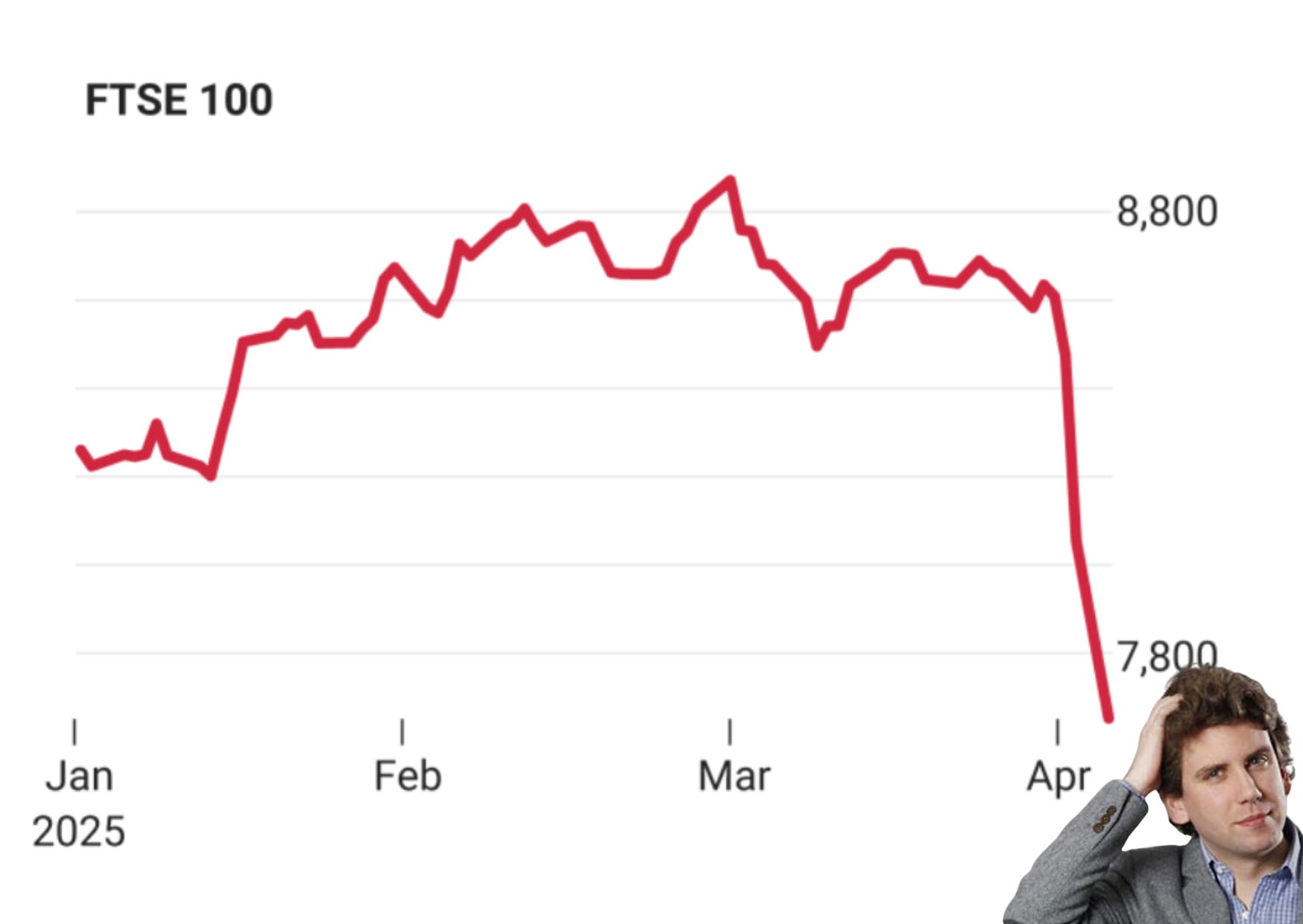
On the day of a global market crash, and with one of Donald Trump’s biggest backers, the hedge fund billionaire Bill Ackman, calling his tariff policy “an economic nuclear winter”, Telegraph columnist Tim Stanley’s latest contribution is headlined, Am I alone in admiring what Trump is doing? Scroll down to the comments section and you’ll find that Stanley might not be alone, but he’s certainly in the minority even among Telegraph readers.
Contrarianism is risky at the best of times, but Stanley filed a column that could turn sour faster than a pint of milk left in the summer sun. Inevitably, the headline’s more extreme than the copy beneath it — dig through it and you’ll find the columnist admitting that “there’s maybe a 10 per cent chance that [Trump’s] experiment will work” — but the piece still requires painful acts of intellectual contortionism.
First, Stanley scratches around for a comparison for US history, alighting on Nixon taking America off the gold standard, reducing the dollar’s value, introducing price and wage controls, and slapping a 10 percent tariff on imports. He claims that “the parallels are spooky” before swiftly admitting that the situation was totally different — the US wasn’t as integrated in the global-trade system, Nixon quickly dropped his plan for tariffs when global recession looked likely, and the response to his actions was a soaring stock market and prices stabilising.
Stanley’s key argument is contained in two paragraphs in the middle of the column:
One has to admire leaders such as Nixon and Trump – or Roosevelt and Attlee – because rather than caretaking history, they attempt to change it. Most Americans don’t understand economics (I struggle with it myself), but economics also doesn’t understand them – their spiritual, as well as material, needs. A prevailing theme in US history is independence: from Britain, from debt, for the freedom to raise a family, beholden to none.

Another is patriotism, America both granting and demanding loyalty. Capitalism has recently pushed itself into a political danger zone because it has outgrown individual and nation, and Trump is implementing a revolution that could’ve come from Left or Right.
The fundamental problem here is the implication that Trump is a visionary and not a vandal, a builder rather than a bully. The line “Most Americans don’t understand economics… but economics also doesn’t understand them — their spiritual as well as material, needs” is bumper sticker writing, a slogan that holds up for the few seconds you’re staring at it before the car in front pulls away at the lights.
Despite believing that Trump’s policy has a 90 percent chance of failure, Stanley is effectively shrugging his shoulders and saying, “Well, at least he’s trying.” It’s an anti-intellectual rationale wrapped up in the language of a chin-stroking historian with a side-hustle as a Thought for the Day preacher.
Stanley’s background in penning homilies for the radio might also explain how he concludes the column:
A recession could decimate the Republicans. Were I a foreign manufacturer, I’d wager this policy will be reversed at least by 2028 when a new president is elected – or big business puts out a hit on Trump, because they’ll tolerate anything but the devaluing of their stock price. The next gun that fires at the president will probably be made in America.The desire for a snappy rejoinder leaves the columnist making an assassination quip.
Stanley has to compare Trump’s plans to Nixon’s policies from the 1970s because the current president’s actions have very little relation to the world as it is in 2025. Claims that he will be able to reindustrialise America and bring back manufacturing jobs to the rust belt ignore how what new factories are built will be dominated by robotics and AI. Those workers who found themselves on the scrapheap are not going to be retrieved from it by Trump’s ‘revolution’.
And Stanley’s praise for the President’s boldness might not go down so well with his readership of retirees whose pensions are now taking a hammering as the real-world results of Trump’s fantasy politics take hold. If there were a market for betting on columnists’ opinions, I’d be shorting Tim Stanley right now.
In the run-up to my book, Breaking: How the Media Works, When it Doesn’t, and Why it Matters, coming out on June 12, I’m publishing an edition of this newsletter every day (excluding weekends and bank holidays). This is number 5 of 50. Thanks for reading. Please consider sharing it…
… and upgrading to a paid subscription:
I love when a columnist openly admits to not having any expertise in a subject and instead argues from a place of ... magical hooey? ...gobbledygook? Also, caretaking isn't a bad thing.
I work in automotive and while many of our plants are very manual and employ a lot of people a) it takes a long time to open a new plant and b) cost pressures are incredible. We recently had to source a component away from Juarez because labor rates had gone up there.
Gough Whitlam rewrote Australia in two weeks in December 1972, locked in a room with Lance Barnard.
Out of that, Australia gained single mother's pension, left the war in Vietnam, ended conscription, free tertiary education, universal healthcare - the list goes on and on and on. He dragged Australia out of the 1950s; Australia before the 1972 election was unrecognisable. That's a visionary.
Trump? Just a regular schoolyard bully. The only difference is that his father was rich and gave him all his money.