
39. Media vs. the machine
A guest post from Professor Kate Devlin – who I also happen to be married to – on AI and the press.
Previously: 'A fantastic guy'
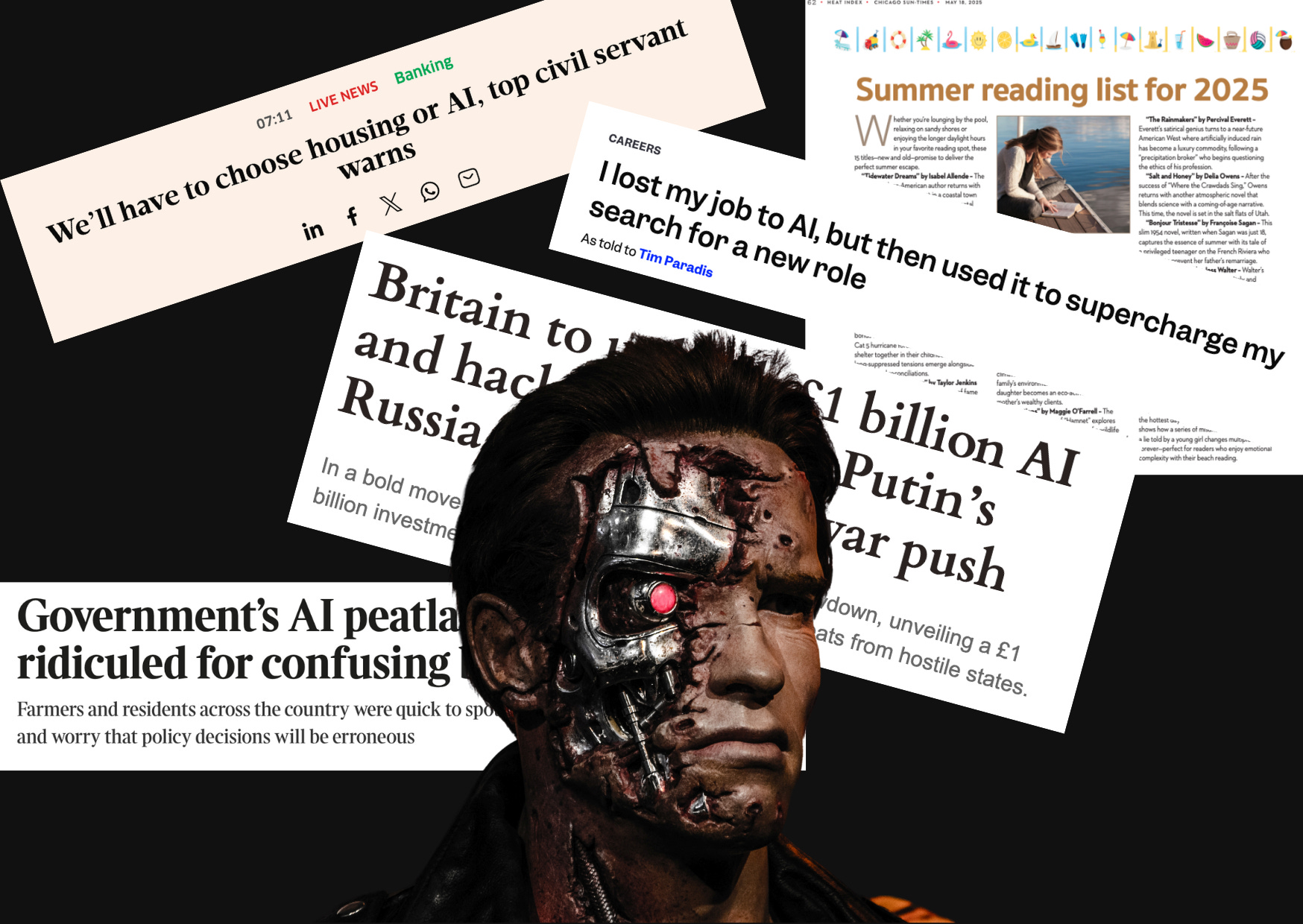
Up popped a headline on Bluesky this week: We’ll have to choose housing or AI, top civil servant warns. “Oooo, tough choice,” said no one. It’s from an Irish paper, but hey, I have an Irish passport nestled beside my British one, so consider today’s newsletter a piece from a semi-migrant to this Island of Strangers, coming over here, stealing your men. The headline might well have been spotted in a UK paper, though. Civil servants in Ireland clearly have to tread the same beleaguered paths as their UK counterparts. Anyway, it’s about AI and so, rather than leaning over Mic’s shoulder, telling him what he should write, I asked if I could do it myself.
It used to be that AI stories were easy to cover: it was going to destroy us all and there was a picture of the Terminator to hammer home the point – a film that was released over 40 years ago and therefore about as relevant to Gen Z as a rotary dial phone. I’d like to say that we’ve moved into more nuanced times, but now we often swing between golden goose (Britain to unleash £1 billion AI and hacking blitz on Putin’s Russia in new cyber war push) and magic beans (Government’s AI peatland map ridiculed for confusing bog with rock).
The nice thing about AI is that it’s a dependable marketing mirage: it gets enough money thrown at it that the hype feels justified, but it’s nebulous enough that it’s promising in the abstract. The current government are its cheerleaders; their AI Opportunities Action plan, published earlier this year, said “AI capabilities are developing at an extraordinary pace. If this continues, artificial intelligence (AI) could be the government’s single biggest lever to deliver its five missions, especially the goal of kickstarting broad-based economic growth.” Well, while we’re on the topic, the creative industries added £126bn to the UK economy in 2022, but apparently that’s the wrong sort of economic growth. The UK’s suggestion to allow big tech companies free access to copyrighted material unless the artists, writers, musicians and performers opt out (via a completely unspecified and non-existent mechanism) was met with entirely justified fury.
Hearteningly, this is where the media stepped up. On the day the government’s AI and copyright consultation closed, every paper in the UK carried a front page with the banner “MAKE IT FAIR” – a campaign uniting newsrooms in their defence of the creative industries. The government received over 13,000 responses to their consultation. People are angry. Why wouldn’t they be?
It’s not just theft of copyright so that tech companies can turn a profit. It’s job loss. It’s Business Insider laying off 21% of their staff this week while embracing AI, in a statement that reads like it’s been 90% generated by using the prompt “justify our redundancies but make it seem like an exciting opportunity”, with the added audacity of pushing out a piece suggesting such things are a wonderful chance for a career-change (I lost my job to AI, but then used it to supercharge my search for a new role). It’s the Chicago Sun-Times’ summer reading list fiasco where a bunch of the recommended books don’t exist because a Large Language Model made them up, because Large Language Models are specifically designed to make things up – that’s what they do, that’s why they exist. It’s Reach rolling out an AI tool to repost stories across its many sites, while telling their journalists to write eight stories per day – stories which readers will give up trying to access because it takes at least 3-5 business days to click through all the pop-ups on the website of your local rag. It’s all of this and it’s the burning planet, the ecological fuckery of generating bland prose in bullet point form.
The thing is, I’m not against AI. It has many, many good uses. Concrete, tangible good uses. It’s not a homogeneous lump of technology. (It’s also not value-neutral, so don’t expect me to use the “it’s just a tool” defence. No, you’re a tool.) But for every social benefit AI brings, there is a company desperate to be top of their game and damn the consequences.
I did not use ChatGPT or any other AI tool to write this piece. I’d rather gnaw off my own hand.
Kate Devlin is Professor of Artificial Intelligence & Society at King’s College London. drkatedevlin.bsky.social
In the run-up to my book, Breaking: How the Media Works, When it Doesn’t, and Why it Matters, out on June 12, I’m publishing an edition of this newsletter every day (mostly excluding weekends and bank holidays). This is number 39 of 50.
Thanks for reading. Please consider sharing this edition…
… and upgrading to a paid subscription:
I feel like tech companies are already creating enough mayhem. They need reigning in. Then a politician starts bleating about AI and I immediately thought, what’s the catch? This whole idea of opting out is outrageous. The idea of AI generated stuff anyway I just hate. It feels like another layer of hell.
Excellent piece, thank you.
Also enjoyed your talk at the Norwich Science festival